Civics
Forsyth County Schools wants to raise your taxes again.
Forsyth County Schools would collect about $13.9 million more in 2026 property taxes while rejecting a rollback rate that would still provide approximately $10.2 million in additional revenue.
July 16, 2026 · Heritage Forsyth · 7 min read
Forsyth County Schools is trying to pull a fast one on us again.
On July 14, Forsyth County Schools announced its intention to keep the school Maintenance and Operations millage rate at 15.208 mills. The legally calculated rollback rate is 15.059 mills.
That difference of 0.149 mills may look small. But according to the school system's own property-tax increase announcement, keeping the higher rate represents a 0.99% tax increase over the rollback rate.
They can technically say they are not raising rates while still raising taxes.
The question taxpayers should ask is simple:
If new development is already providing millions of dollars in additional revenue, why must existing taxpayers give the school system even more?
What is a millage rate?
A millage rate is the amount of tax charged for every $1,000 of assessed property value. One mill equals $1 for every $1,000.
Georgia generally assesses property at 40% of its fair market value. A home worth $500,000 therefore starts with an assessed value of $200,000 before exemptions. The Georgia Department of Revenue explains the calculation.
A homeowner's final bill also depends on exemptions and changes in that individual property's taxable value.
Why a flat rate can still be a tax increase
Imagine the school tax digest as a large bucket filled with taxable property.
The millage rate is the size of the scoop the school system uses to collect money from that bucket.
New houses, stores, offices and property improvements make the bucket larger. Rising assessments on existing property also make it larger.
The rollback rate uses a slightly smaller scoop to offset the increase caused by reassessments. It does not take away the additional revenue generated by new development.
Forsyth County Schools wants to keep using the larger scoop on the larger bucket.
That is why saying “we did not raise the rate” does not mean “we did not raise taxes.”
The Georgia Property Taxpayer's Bill of Rights makes this distinction clear. When a taxing authority does not adopt the rollback rate, it must notify the public that taxes are being increased and hold three public hearings.
What the 2026 digest shows
The school system's official five-year tax digest notice reports:
| School M&O tax measure | 2025 | 2026 proposed | Increase |
|---|---|---|---|
| Total taxable assessed property value (net tax digest) | $23.871 billion | $24.784 billion | $913.6 million |
| Millage rate | 15.208 | 15.208 | No rate change |
| Taxes levied | $363.0 million | $376.9 million | $13.9 million |
For example, applying the proposed 15.208-mill rate to the $24.784 billion net tax digest produces a gross school M&O property-tax levy of approximately $376.9 million. The school system's separate FY27 operating budget is approximately $762.5 million—not $24.784 billion.
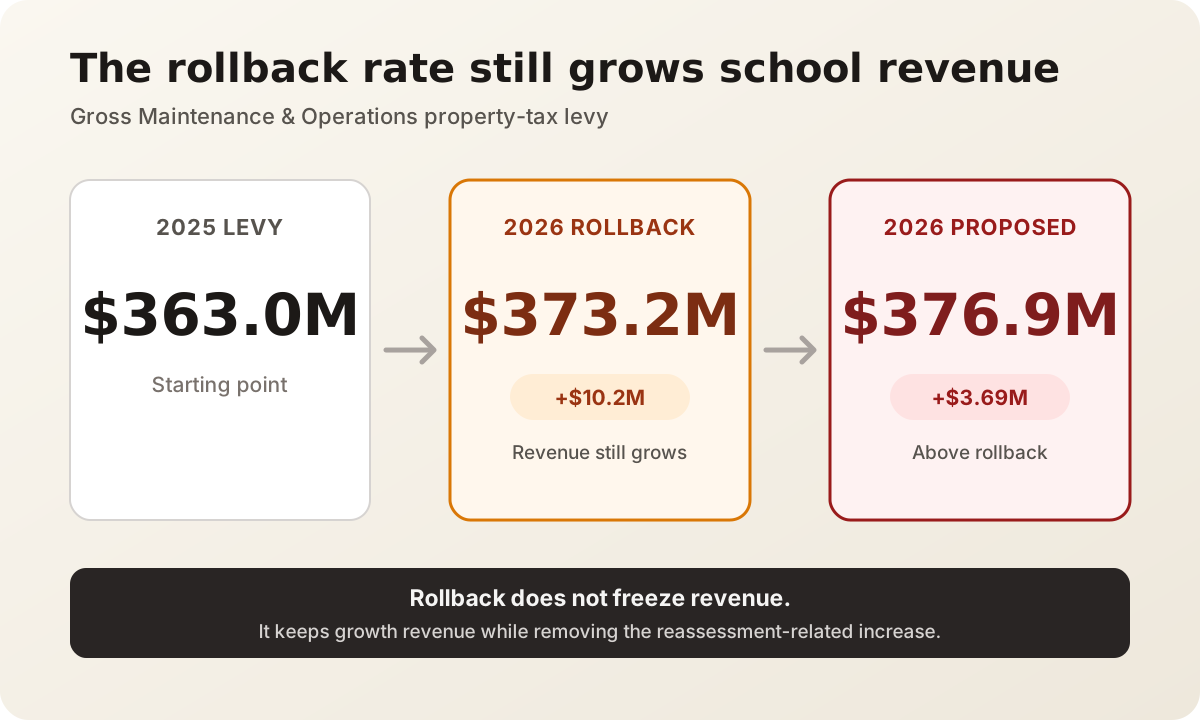
The tax digest grew by 3.83%. Because the school system proposes keeping the same rate, its gross property-tax levy would also grow by approximately 3.83%, or $13.9 million.
But that is not the only option.
At the rollback rate of 15.059 mills, the school system would still levy approximately $373.2 million. That is about $10.2 million more than last year.
In other words:
- New development and other non-reassessment growth would still provide approximately $10.2 million in added revenue.
- Rejecting the rollback rate adds another approximately $3.69 million.
- The rollback rate is not a revenue freeze or a budget cut.
- It simply prevents the school system from collecting the reassessment-related increase from existing property.
Our calculation using the state's rollback formula indicates that roughly $670.7 million of this year's digest growth came from new construction, property improvements and other non-reassessment changes. Approximately $242.8 million appears related to reassessments.
The published digest does not provide a category-by-category accounting of that $670.7 million. It should therefore be understood as estimated non-reassessment growth, not as a claim that every dollar came from new construction alone.
What does it cost a homeowner?
The proposed rate is 0.149 mills above the rollback rate.
That equals approximately $5.96 for every $100,000 of fair market property value before property-specific exemptions.
| Fair market value | Approximate additional tax over rollback |
|---|---|
| $300,000 | $17.88 |
| $500,000 | $29.80 |
| $650,000 | $38.74 |
| $750,000 | $44.70 |
| $1 million | $59.60 |
Forsyth County Schools uses the same $38.74 example for a $650,000 home in its announcement.
That may not sound enormous by itself. But taxpayers are not responsible for only one government bill. They are also paying higher prices for groceries, insurance, utilities, repairs, rent and nearly everything else.
Property-tax increases also affect landlords and businesses. Those costs can eventually appear in higher rents, higher prices or fewer local investments.
Most importantly, these increases can compound year after year.
Does the budget require this increase?
Forsyth County Schools has legitimate expenses.
Its FY27 budget identifies approximately $7.6 million in additional state-mandated retirement, healthcare and literacy-coach costs. New development can also mean more students, buses, teachers and classrooms.
But growth brings new tax revenue with it.
The official FY27 budget's expenditure table shows that the proposed operating budget increases spending by approximately $12 million, or 1.60%. At the rollback rate, property-tax revenue would still grow by about $10.2 million before collection costs. State and federal revenue is budgeted to increase by another $3.45 million.
The district does expect declines in several other revenue sources, including interest income and title ad valorem taxes. Those declines deserve consideration.
Even so, the official budget's fund-balance table shows:
- $1.28 million more in revenue than expenditures;
- an estimated $116 million ending fund balance; and
- a fund balance equal to approximately 15.21% of expenditures.
Using the budget's own collection and commission assumptions, adopting the rollback rate would leave an adjustment of approximately $2.31 million after applying the already-budgeted surplus.
That is about 0.30% of the operating budget.
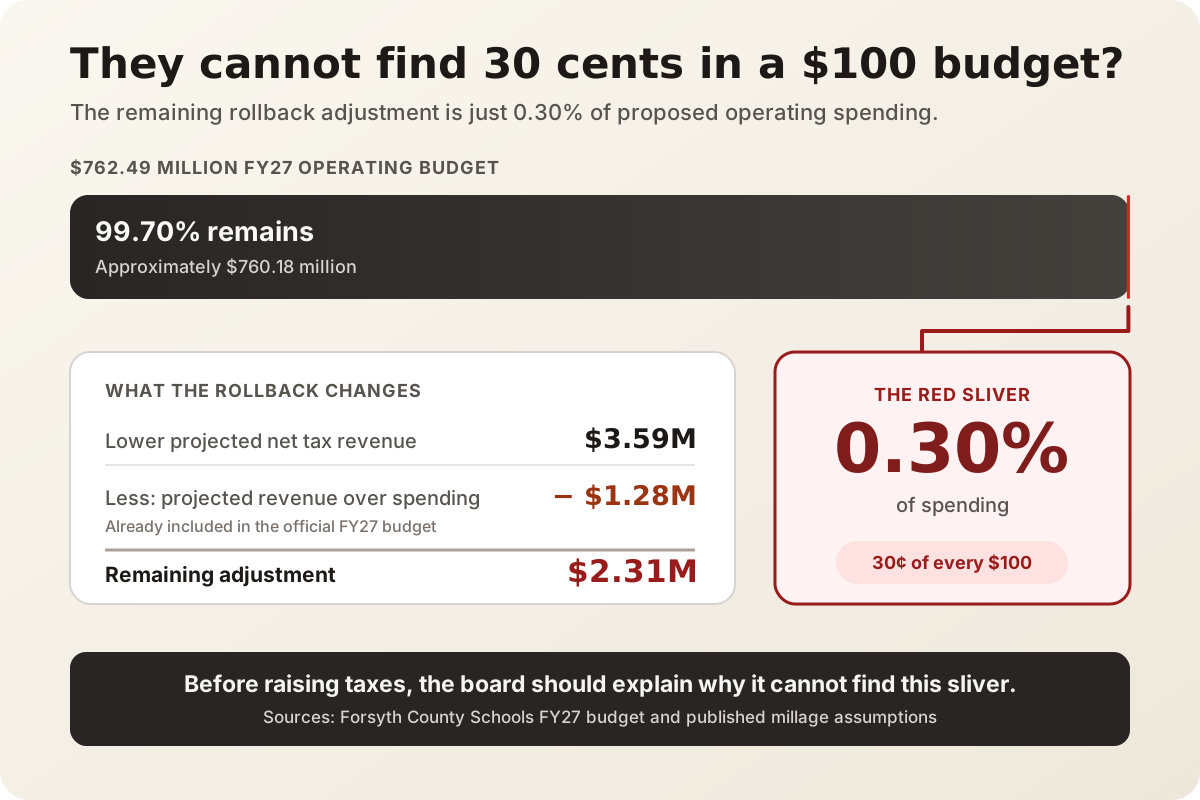
Before increasing taxes, the Board of Education should explain why it cannot find a 0.30% adjustment in a budget exceeding $762 million.
The questions the board should answer
Good schools are important. Teachers, bus drivers, nurses and support staff deserve to be paid fairly. Students deserve safe and well-maintained schools.
But supporting public education does not mean taxpayers should automatically accept every increase.
The Board of Education should publicly answer:
- Why is approximately $10.2 million in additional revenue at the rollback rate not enough?
- What specific programs or positions require the additional $3.69 million gross levy?
- Why can approximately $2.31 million not be adjusted in a $762.5 million budget?
- Why do budget materials advertise “no millage rate increases” without equally emphasizing the legally required property-tax increase?
- What savings were considered before asking residents to pay more?
If the additional money is truly essential, the board should identify exactly where every dollar will go.
If it cannot do that, it should adopt the rollback rate.
Taxpayers can speak before the vote
Forsyth County Schools has scheduled three hearings at its Central Office, 1120 Dahlonega Highway in Cumming:
- July 23, 2026, at 9:00 a.m.
- July 23, 2026, at 7:00 p.m.
- July 30, 2026, at 5:00 p.m.
The millage rate is scheduled to be set after the final hearing.
The bottom line is this:
Forsyth County Schools can adopt the rollback rate and still levy about $10.2 million more than last year. Keeping the existing rate adds another $3.69 million to the gross levy. Before taxpayers are asked to provide that additional revenue, the Board of Education should publicly identify the exact need, explain why the revenue provided by new growth is not enough, disclose what alternatives or spending reductions were considered, and show taxpayers exactly where the additional money will go.
Taxpayers should attend the hearings, ask those questions directly and hold every board member accountable for both the answer and the final vote. “The rate did not change” is not a satisfactory explanation. The public deserves a clear demonstration that the money is necessary.
Related Stories
Civics
Forsyth County Schools Calendar 2026-2027Forsyth County, Georgia 2026-2027 school calendar with key holidays, breaks, early release days, and Apple/Google Calendar links.
June 4, 2026 · Heritage Forsyth · 1 min read
Civics
Forsyth County Elections: November 2026 General and Special Election Ballot GuideA Forsyth County ballot guide for Georgia's November 3, 2026 general and special elections, with federal, statewide, county, school board, legislative, conservation district, and ballot-question research.
July 15, 2026 · Heritage Forsyth · 20 min read

Civics
Forsyth County Elections: June 2026 Primary Runoff ResultsForsyth County results for Georgia's June 16, 2026 general primary runoff.
June 16, 2026 · Heritage Forsyth · 1 min read