Culture
The Road to Frogtown
A 1968 Atlanta Journal and Constitution Magazine journey through Frogtown, the Old Federal Road, Settingdown Creek, and the stories surrounding Chief James Vann.
April 18, 2026 · Heritage Forsyth · 16 min read
Frogtown, Ga. ... where you can get away from almost everything.
This story was originally published in The Atlanta Journal and Constitution Magazine on June 16, 1968. Written by Andrew Sparks. Photography by Kenneth Rogers.
Originally published as "Frogtown, Ga. ... where you can get away from almost everything."
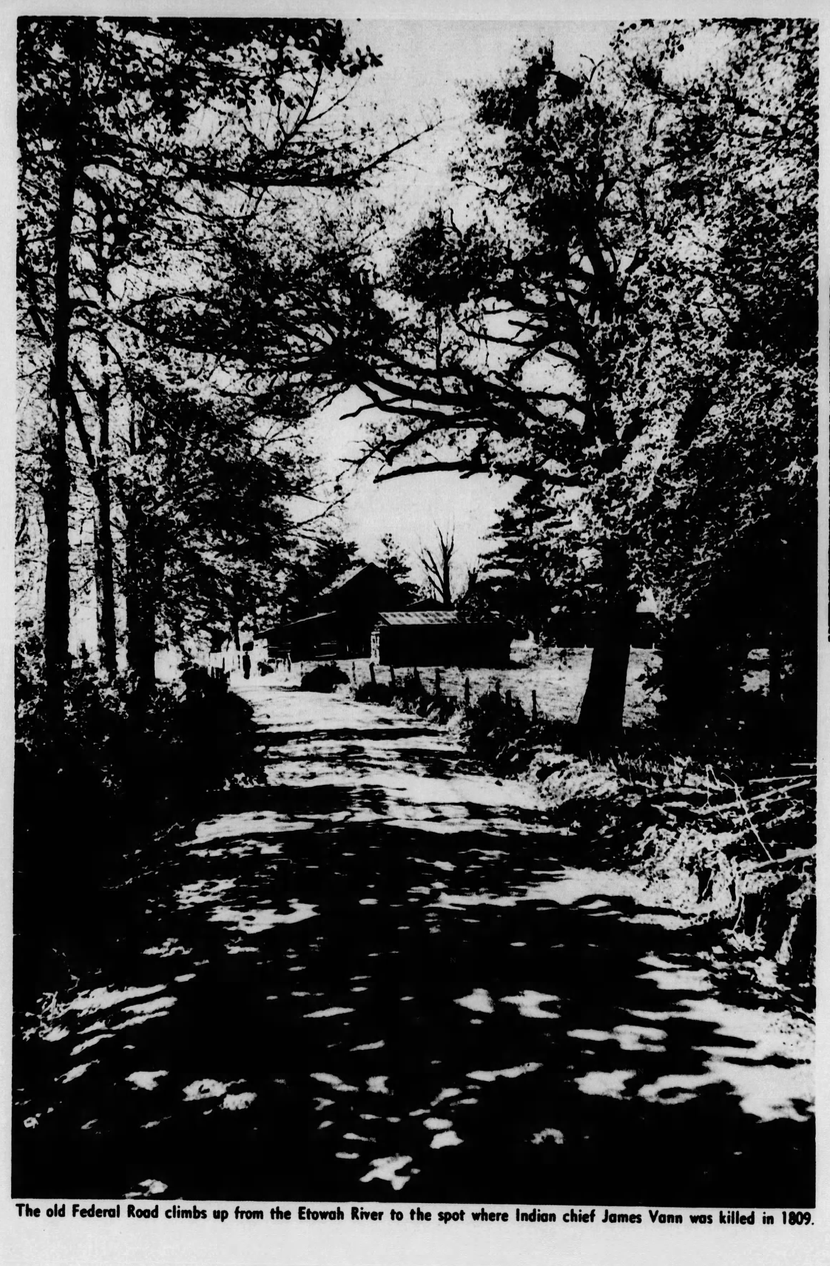
"You ought to go to Frogtown," a friend said, recommending a backwoods, off-the-beaten-path place to explore. "But you won't know it when you get there.
"It's north of Atlanta, although the place to start," he continued, "is down at Jonesboro."
The man talking was Joe Hurt, museum curator at Fernbank Science Center, collector of old general-store paraphernalia, former buffalo stuffer at the State Capitol, and one-time map maker and display artist for the Georgia Historical Commission. His ancestors came from Frogtown and his great-aunt, Miss Grace Lee Heard of Jonesboro, he said, knows a lot more about it than he does.
"After you've talked to Miss Heard," he added, "go to Coal Mountain on U.S. 19, north of Cumming, and turn left -- you'll then be on the old Federal Road the U.S. government built through the Cherokee Indian nation. It will take you to Matt, Ga., but you won't know when you get there, either, unless you see Hurt and Moore's store. It's been there about 80 years and still has a crank phone on the wall and kerosene lanterns hanging from the ceiling. Miss Ollie Hurt and Roy Moore, who run the store, could steer you to Frogtown.
"Ernest Sherrill lives just across the Etowah River from Frogtown on the farm where James Vann, an Indian chief, was killed 159 years ago. He was murdered in a little tavern -- Buffington's Tavern -- which stood in Mr. Sherrill's front yard. The two-story log house where one of Vann's relatives lived at the time of the murder stands just across the old Federal Road from Mr. Sherrill's house.
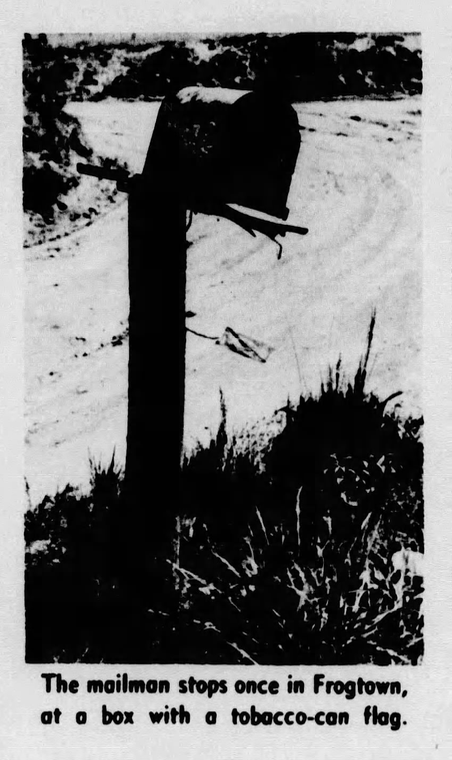
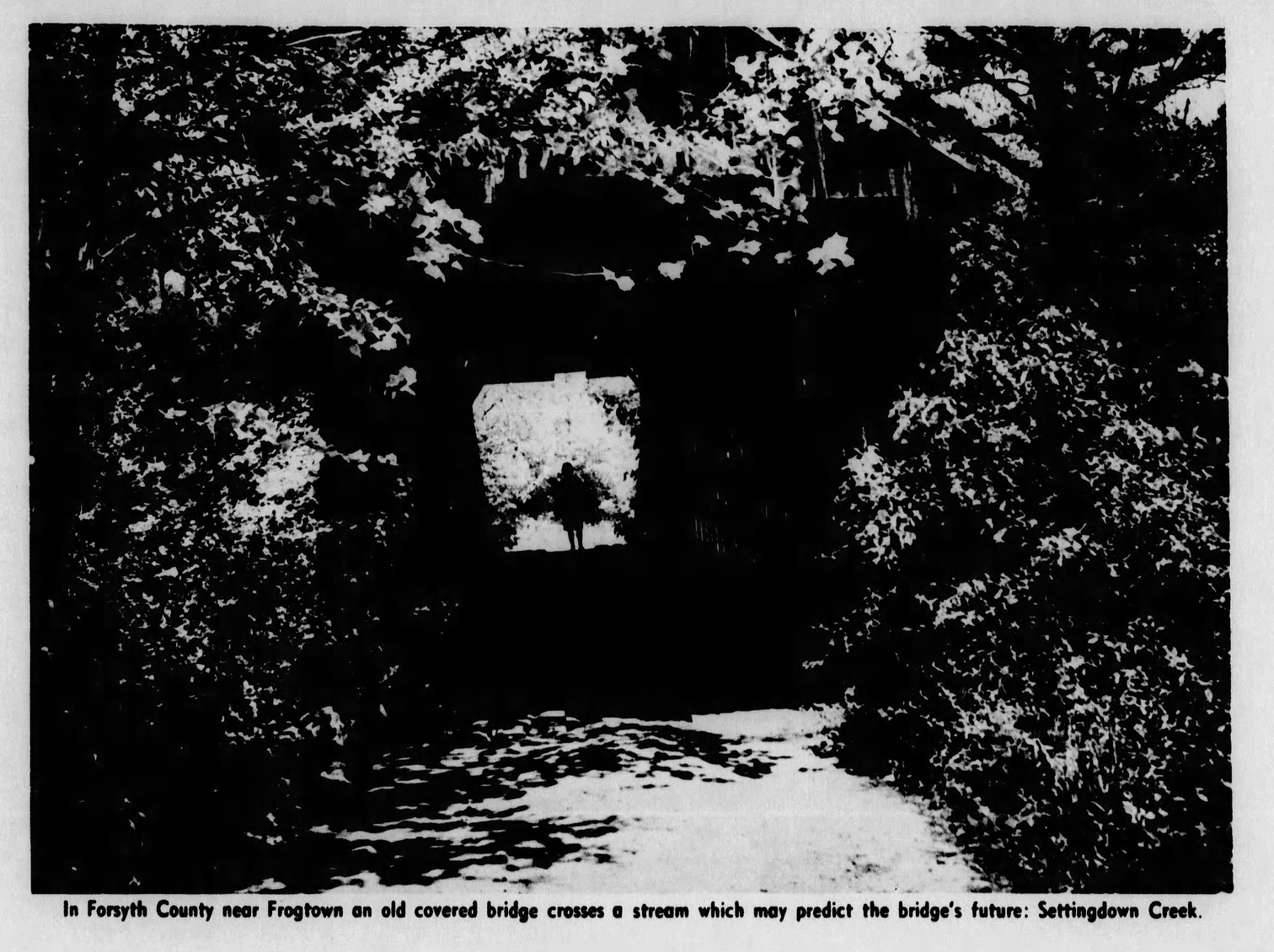
"This is isolated country, almost a frontier, and still wild. In the area you can see an old covered bridge over Settingdown Creek and the remains of Poole's Mill which ground corn at the shoals nearby. I've heard there used to be a gold mine where Settingdown Creek runs into the Etowah, but the river flooded the mine and it had to be abandoned. My great-great-grandmother told me about some large rocks nearby with lots of Indian carvings on them, but I never found them."
Miss Heard lives near Jonesboro in a right historic spot herself, the old Fair of 1850, a collection of ancient buildings the late Col. John West assembled to give a picture of Georgia a century ago; the old houses, farm buildings and a Hall County brush arbor where Benjamin Parks, who started the Georgia gold rush, used to worship, are now being moved to Lumpkin, Ga. There they will become part of a new restoration village called Westville.
"Frogtown," said Miss Heard, "is the name of the place where I was born, but there's nothing left there now to make pictures of.
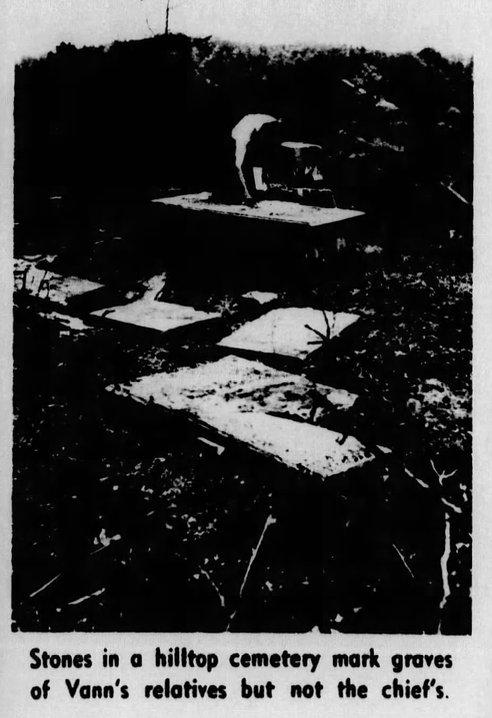
"When I was small, I remember seeing old James Vann's grave on what's now Ernest Sherrill's farm. They say the cemetery has washed badly, but I couldn't even tell exactly where the old Indian grave was the first time I saw it. My mother said it used to have a wooden shelter over it with a fence around it, and that the marker was a wooden slab, carved by hand, a beautiful thing. My mother was 94 when she died last year. When she could first remember, the shelter had already rotted and fallen down. She memorized part of what was on the marker. It began,
Here lies the body of Jim Vann.
He killed many a white man.
She had forgotten the middle, but it was a kind of jingle that ended.
At last by rifle ball he fell,
And devils dragged him down to hell.
"I said, 'Mama, that wasn't on his grave marker!' and she said, 'Yes, it was.' Nobody I knew could remember all the verses.
"The old house where Vann's niece lived -- she was a Mrs. Blackburn -- stood where my cousin Ernest Sherrill lives in a big white house his father built after he moved the Indian log house across the road to use as a barn. The log house has ceiling inside and planking outside and a little winding stair that went up to the second story. One of Vann's nieces married Robert Rogers -- they were the grandparents of Will Rogers, the humorist."
"James Vann, I always heard, was a mean Indian. When he got killed, he was coming down from Spring Place and passed through a spot where a man lived he threatened to kill. After Vann went on, someone told the man, and he and a friend followed Vann on horseback. Down at Vann's niece's place, there was a little house in the yard, a kind of saloon, where they kept whisky to sell. When Vann went in there, one of the men got off his horse and followed him in to get a drink. He maneuvered Vann around until he got in line with the window, and the other man waiting outside shot him. Vann tried to crawl out the window after the man, but he died right there.
"That little house or tavern was still standing when my mother was a girl and she remembered seeing the blood stains. That's how straight the story came to me."
The only contemporary account of the Vann murder is in the diary of Moravian missionaries who came down from North Carolina to north Georgia to bring Christianity to the Indians early in the 19th century. The German diaries, translated for the Historical Commission by Dr. Carl Mauelshagen, recorded the "frightful news" on Feb. 21, 1809.
According to the report, Vann had an Indian shot for refusing to submit to punishment. Vann was a notorious drinker and apparently pitched a big one after the shooting.
"For several days since then," the diarist wrote, "he had been lounging in Tom Buffington's tavern and drinking excessively. The tavern of half-Indian Buffington is about 56 miles from here. Here Vann, with several of his former friends, against whom he had developed a grudge in his heart, quarreled, and he miserably abused one of them and threatened him with violence.
"Toward midnight he was seated at a table which faced the open outer door, and as he arose, squarely facing the open door, a shot from without pierced his heart, and his lifeless body fell to the floor. No one positively knew who had shot him. ..."
Vann's young son Joseph had gone with him on the trip. After the shooting, everything the Vanns had with them was stolen -- even the clothes of the boy and his father and a pocketbook containing a large sum of money in bank notes. Young Joseph, who was about 12, "wrapped himself in a blanket and with a Negro fled to his father's plantation along the Chattahoochee about 13 miles from Buffington's."
"In Vann's lifetime," Miss Heard said, "there was nothing hardly in north Georgia. That area was still a wilderness."
One bright spot in that wilderness was James Vann's house at Spring Place, a red-brick, white-columned mansion, now carefully restored and maintained by the Historical Commission. The magnificent Federal woodwork, fine as a Philadelphia house, the gay and stylish color schemes -- white-walled rooms with woodwork painted red, yellow, green and blue -- and the cantilevered staircase must have seemed grand indeed in north Georgia when the house was built in 1804. James Vann lived there only five years before his murder down at Frogtown, but he lived elegantly, a Scotch-Cherokee half-breed who was master of a 4,000-acre plantation, 100 Negro slaves and two wives at the same time, according to legend. After Vann was murdered -- shot probably by relatives, vengeful because he had killed his brother-in-law John Falling in 1807 in a duel fought on horseback -- his young son Joseph inherited the north Georgia mansion and lived there until 1834 when the Cherokees were forced to leave Georgia.
At Coal Mountain, on U.S. 19, historical markers point out the old Federal Road which James Vann had persuaded the Indians to let the government build. He had a tavern which stood near Oscarville on a site flooded by Lake Lanier. That building has now been reconstructed at New Echota, the Cherokee capital. It may have been the house young Joseph fled to after the murder.
The Federal Road west of Coal Mountain is the most romantic kind of backwoods Georgia -- loaded with Indian tales, old gold mines, prosperous-looking chicken houses, scenery rimmed with blue horizons humped up with mountain peaks. It is rural and pleasant, lined with neat white houses, mowed grass yards, fruit orchards, lush pastures in the creek bottoms. Almost any Georgia back road is beautiful, if you get off a well-traveled highway, but not all of them are as full of history as the old Federal Road. It was the first vehicular road and the earliest postal route west of the Chattahoochee and long before that was a trading path from Augusta to the Cherokees in north Georgia and Tennessee.
The Indian inns are closed, but travelers can stop for a cold drink and conversation at Hurt and Moore's in Matt, four miles from Coal Mountain. The houses thin out before you get there.
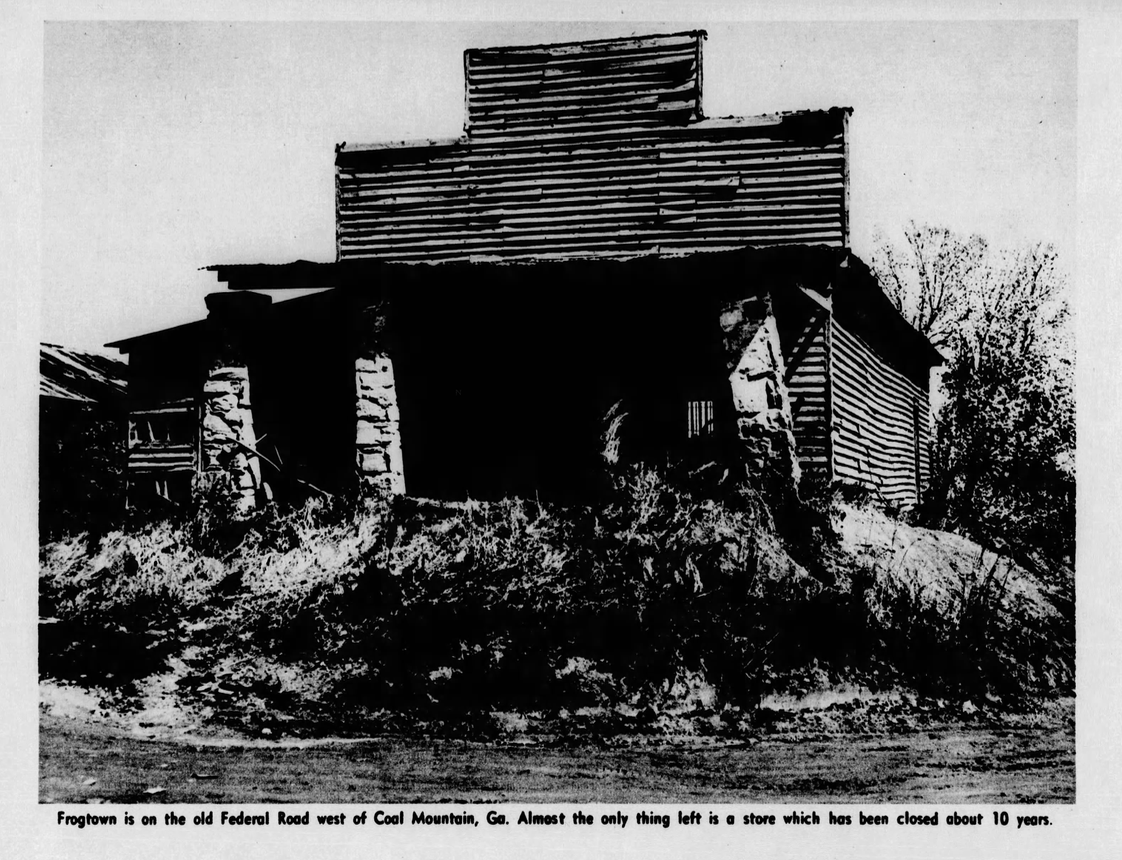
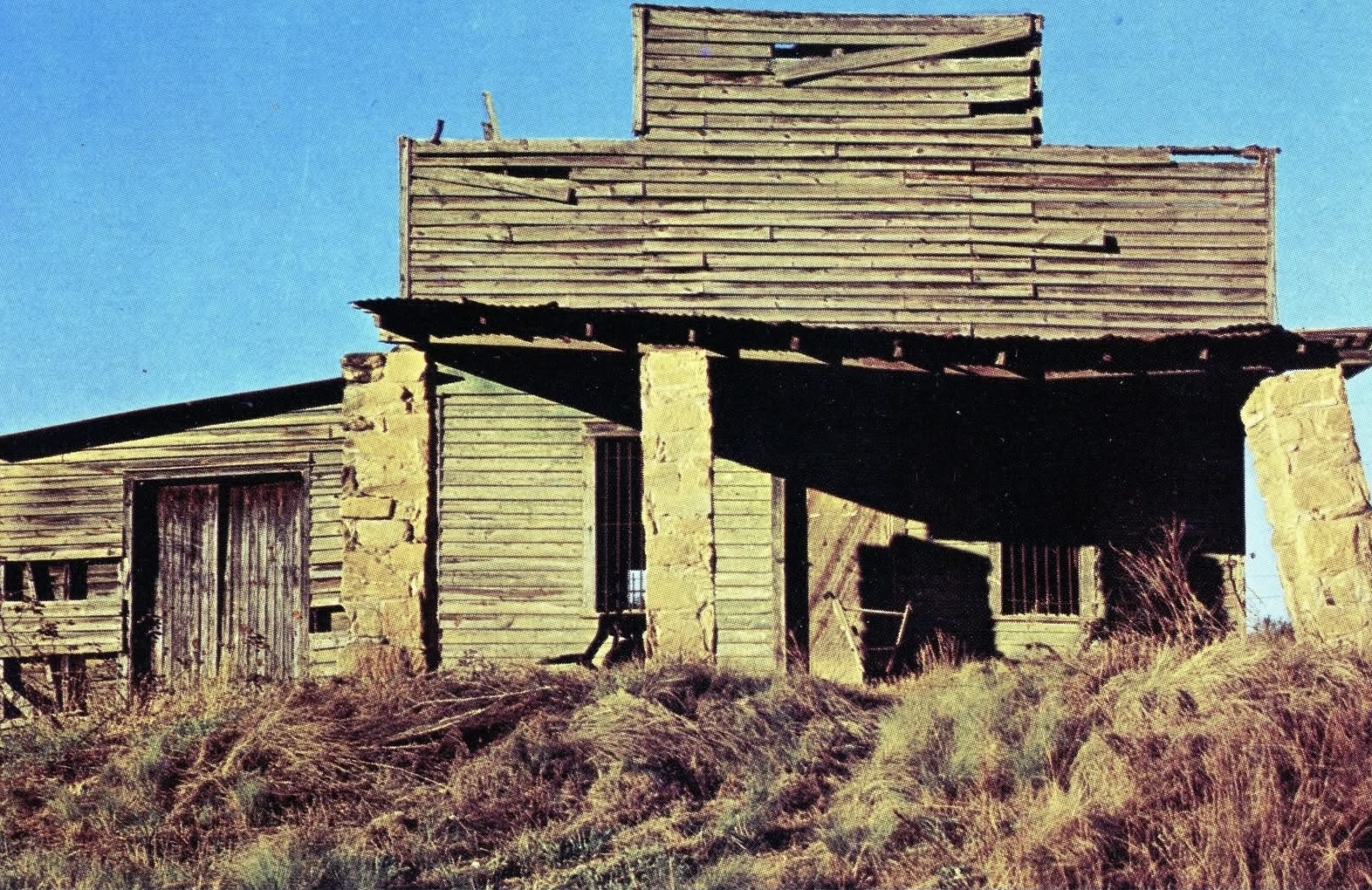
"Last summer a girl living at Frogtown saw a bear down at the river," Miss Olive Hurt said at the store. "We asked her what she did and she said, 'I ran, hollering as loud as I could, and that dog with me beat me to the house.' She lived on the hill behind the old store at Frogtown, a wooden building with stone pillars. Hasn't been any goods in that store for 10 years or more.
"Frogtown was a pretty thickly settled village once. Not much is left. I've lived in hollering distance of here all my life."
At Frogtown the old store has three stone pillars that have begun to assert their independence; one leans crazily and another doesn't even make contact with the roof. Rusty plows and harrows fill the porch.
If you continue on the pavement, and turn left on the first dirt road after the center stripe ends -- that was Roy Moore's specific direction -- you'll reach the old covered bridge on Settingdown Creek. The dirt road winds through woods, an old road cut like a ditch with vertical sides sliced into the red hills. It makes a right-angle turn into the shadowy bridge, which is brighter now than it used to be because a lot of its vertical siding has disappeared. The crosshatch of thick, pegged-together timbers makes a diamond pattern of light inside. Upstream there's a natural millpond; downstream, a noisy shoals where Settingdown gets up on its feet and runs, jumps over rocks, splashes over falls, splits at well-worn granite outcrops and dashes together again. Poole's Mill burned a couple of years ago, and now young trees grow inside the stone foundation.
Peaceful as it looks, a shoals is a place of violence. Rocks are smoothed and worn by the ceaseless torrent. Old logs are hurled into unlikely places by raging flood currents. Tree roots patiently pry rocks apart, splitting granite which a man would find difficult to break with dynamite and power tools.
Time has been violent with the bridge, too. The metal roof is rusted through. Some of the wooden roof supports are broken. Signs at the entrances warn of a five-ton load limit. For the bridge, Settingdown Creek's name foretells the future.
Back at Frogtown, a dirt road leads down to the Etowah River, spanned by an old bridge with delicate iron railings. Across the river, the Federal Road cuts through pastures in the river bottom and then climbs a hill to the Sherrills'.
Ernest Sherrill was down by his pond in a pasture, a rifle on his knees which he had carried along to shoot snakes.
"I'm 71," he said. "We took that old Indian house across the road when I was about 10 years old. A fellow named Moore moved it.
"The day before, 40 or 50 men came here and tried to move it with a block and tackle and couldn't even make it budge. The next day the Moore fellow came up here with just one man to help him, jacked the house up, put rollers under it and pulled it across the road with a mule and something like a syrup mill.
"Have you ever seen a syrup mill, the kind pulled by a mule? That's what it was like."
"The rollers," he explained, "were short sections of little logs, about a yard long and six or eight inches thick. The house mover put down a track of heavy pieces of wood for the rollers to run on. Out in front of the house, he set a short post about three feet deep in the ground. The post had a sweep attached to the top, just like a syrup mill, and the mule pulled the sweep around. As he walked, a cable attached to the foundation of the house wrapped round and round, pulling the house toward the post. When it got close, the post was moved to a new spot and the process continued. As the house moved along, the rollers and track it passed over were picked up and put down in front. Moving the house was so easy, Mr. Moore let four or five little boys start it before he hitched up his mule."
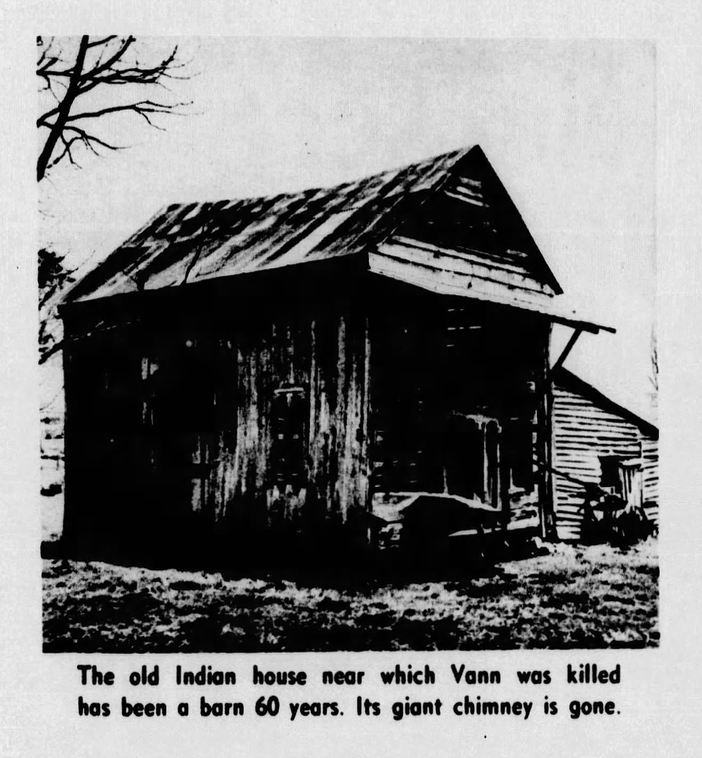
"What's left of the house is not nearly all there used to be," Mr. Sherrill said. "It had rooms running off in several directions with a great big old hall, open with no doors. One set of rooms was bigger than the house that's standing there now. There were 10 rooms to my knowledge, and probably four or five went before I knew anything about it. The big brick and rock chimney wasn't rebuilt when the house was moved.
"We always understood that old Chief Vann built the house, but I wouldn't say if it was him or his sister, who I heard was living here when old Vann got killed.
"I'm satisfied I must have seen the marker on his grave, but I don't remember it. It was made out of rich timber and had a cross with some verses on it. Vann's brother-in-law might have put it up, and I think it was a brother-in-law who killed him.
"What I heard was that Vann told his sister, 'I've already killed one man and I'm going to kill another one before I eat breakfast.' But he went on and ate, and his sister helped plot the thing that got him.
"Part of his marker read:
Feared by all white men
And dreaded by the Indian
Killed one man too many
But his brother-in-law killed him.
"It was a rigermarole, that verse.
"I think they hastily buried him, but there are tales about gold in his grave. We got a letter from somebody at the state capitol once, stating that if we'd let them dig Vann up, and if any treasure was found, we'd get it. Once his great-grandson came in here and he said, 'Whatever's in that grave is y'all's.'
"Some folks did come here once with a professional digger to dig up the grave. I wasn't going to show them where it was, but they claimed they knew. I said, 'You folks are out there on the Negro side of the cemetery,' but they dug anyway. They took the bones off somewhere for a month, but they found out it was a Negro and brought them back and buried them again."
An archeologist who examined the remains of the body proved it couldn't have been James Vann. The grave contained pressed-glass shirt buttons invented in 1825; a riveted brass and iron button from bib overalls, of the kind made in San Francisco by Benjamin Levi in the 1850s, or later, and a gold-plated wedding ring marked (falsely) "18 k," a labeling which was not required by law until 1873. Because of certain physical characteristics, he concluded that it probably was a Negro, who had been buried some 80 years after Vann was murdered.
"My Aunt Mattie -- Grace's mother -- showed us where the grave was," Mr. Sherrill went on. "There are two washes coming out of the cemetery and she always told us it was the first one.
"Ain't nobody ever dug into the right grave. I'd love to see in it before I leave here, but I have no idea anything is in there. That's what we've believed all my life.
"Folks from the state have done everything they could to get that old Indian house. They're on to us now. But I don't guess I'll ever let it be moved. What we ought to do is pull away those old sheds and cribs, and remodel the log house to look like it used to.
"I'd love to see it the way it was. It was well ceiled inside and looked like it had been painted by somebody who took a brush and gave it a little flirt, spattering the walls with paint. The background was gray, covered all over with little drops of blue or black and white. You can still see paint on a few of the planks under the stair steps.
"That house shined in its day. It's all faded now."
The old house is built of wide, flat logs, up to 15 inches across, so wide that the walls on the first floor are only five logs high. Partitions are missing now and the house has only one room on each floor, almost 20x30 feet. The downstairs room has an outside door on three sides, and an enormous eight-foot opening on the fourth where the giant fireplace was. That speckled paint is still bright. The doors once were even gayer -- black, with red panels outlined in white. Most of the inside sheathing has disappeared.
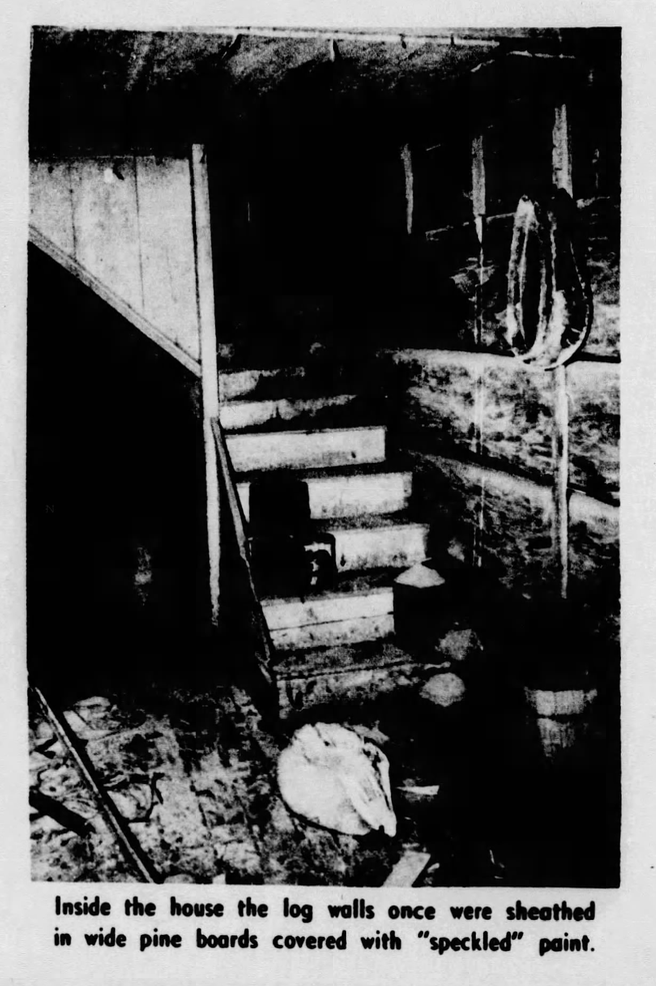
"What went with lots of it," Mr. Sherrill said, "was us boys would need stove wood in the winter and we burned it up. We also tore boards off to make rabbit boxes. I don't know why our daddy let us do it."
Signs of the Indians are almost all gone, including most of the sturdy houses of the white-and-Indian half-breeds. One day only names will be left.
"The river," Mr. Sherrill said, "is called Hightower or Etowah, which means swift out of the Indian language. It's one of the swiftest waters you can find.
"Frogtown isn't Indian. How come this place got the Frogtown business is some old fellow came through here traveling. Frogs is bad when it comes a fresh. When it's dry and we have a rain, then there's the most music you ever heard. This old fellow woke up and all the frogs were singing and he named it Frogtown."
Frogs are almost all that's left.
Related Stories
History
Eldo Grogan: Soldier and Poultry Pioneer of Forsyth CountyWorld War II veteran, poultry pioneer, banker, and longtime Cumming businessman whose work helped define a growing county.
May 29, 2026 · Heritage Forsyth · 5 min read
History
The life of a Forsyth County country doctorGenerations of Bramblett's have cared for Forsyth county residents.
January 13, 2026 · Heritage Forsyth · 6 min read
History
Almon C. Hill: The educator who helped shape modern Forsyth CountyCoach, superintendent, school board member, and one of the most influential education leaders in Forsyth County history.
January 2, 2026 · Heritage Forsyth · 3 min read